La Grotta dei Piccoli 2026 – Cinema Workshops in Schools

“La Grotta dei Piccoli” is an educational project organized by the Associazione La Guarimba and implemented between January and March 2026 within the national programme “Cinema e Immagini per la Scuola 2025”, promoted by the Italian Ministry of Culture and the Ministry of Education and Merit.

For two months we travelled across Calabria with a simple but ambitious goal: bringing cinema where cinema no longer exists. In sixty days of work we travelled 5,912 kilometres, reaching small towns, inland areas, urban outskirts and coastal communities. We transformed classrooms, libraries and school gyms into temporary cinemas, bringing films to places where cinema often disappeared decades ago — or where it never existed at all.

During the project we organized 103 film screenings, reaching 5,912 spectators, and 107 cinema and animation workshops, generating 1,743 participations in educational activities. For many students, this was their first encounter with cinema as an artistic language.

PROJECT PARTICIPANTS

The project involved 13 schools distributed across the five provinces of Calabria, reaching dozens of campuses and local communities. Participating institutions included: IC di Belmonte, Istituto Comprensivo Amantea Campora Aiello, IC Mangone Grimaldi, ICS Mendicino, Istituto Comprensivo Statale “Via Roma – Spirito Santo”, IC Mameli-Manzoni Amantea, IC Davoli Marina, Polo Liceale Campanella-Fiorentino, I.C. K. Wojtyla-G. Da Fiore, I.I.S. “F. Severi”, Istituto Comprensivo “Catanoso De Gasperi San Sperato Cardeto”, I.C. Sant’Onofrio, I.C. Montebello Jonico – Motta San Giovanni.

Through these institutions the project reached several towns and communities: Belmonte, Longobardi, Fiumefreddo Bruzio, Amantea, Lago, Campora San Giovanni, Belsito, Grimaldi, Piano Lago, Santo Stefano, Piane Crati, Paterno Calabro, Mangone, Mendicino, Rosario, Tivolille, Cosenza, Davoli Marina, Lamezia Terme, Isola di Capo Rizzuto, Gioia Tauro, Reggio Calabria, Cataforio, Mosorrofa, Saline Joniche, Fossato Jonico, Lazzaro, Motta San Giovanni, Masella, Sant’Elia di Lazzaro, Sant’Onofrio, Filogaso, Maierato and Stefanaconi.

In many of these places there is no active cinema theatre. Bringing cinema into schools meant offering thousands of students their first real access to film culture and creating a shared experience of viewing, discussion and reflection.

FILM SCREENINGS

During the project we organized 103 film screenings, reaching a total of 5,912 spectators. The programme was designed to adapt to different age groups, with specific selections for kindergarten, primary school, middle school and high school, ensuring that each student encountered stories and cinematic languages appropriate to their age.

Each screening was introduced by a cinema expert, who presented the films and explained elements of animation language. After the screenings, students participated in discussions, turning the viewing into an educational and participatory experience.

An important part of the project also took place at the Cinema Sicoli in Amantea. In the morning we welcomed students from the Pascoli and Manzoni middle schools, who experienced cinema together with their classmates. In the afternoon we invited children from Amantea’s kindergarten together with their parents, turning the screening into a shared moment between school and family and making cinema a community experience.

STOP MOTION WORKSHOPS

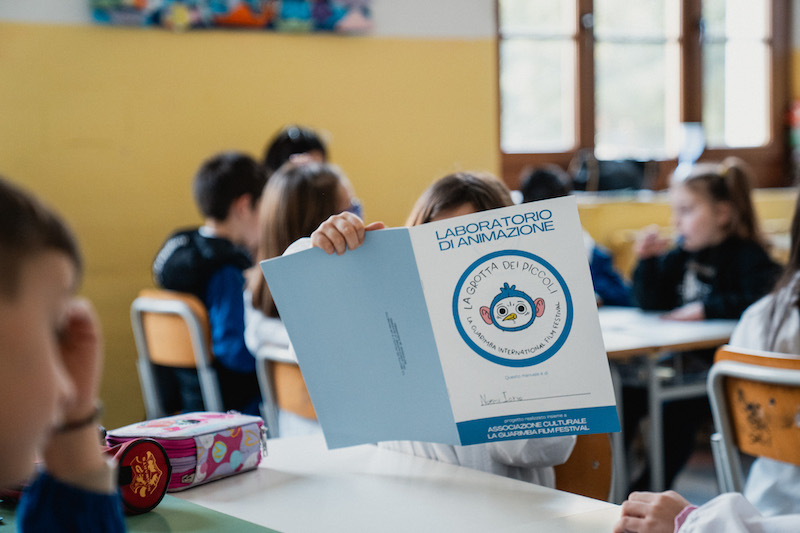
The stop motion workshops were designed as a longer and more immersive learning path, structured across four days of work. Each group of participants was guided through all stages of producing a short animated film, from the birth of the idea to the final screening.

To run the workshops we provided tablets, tripods, the Stop Motion Studio app, plasticine, modelling tools and a specially designed illustrated manual explaining each step of the process in a clear and accessible way. The manual also included a cut-out character mask and visual materials to help students imagine characters and structure their workflow.

Participants were divided into teams and together decided on characters and stories to tell. They then built their protagonists with their own hands, modelling plasticine and designing environments, expressions and movements. The process proved to be an important exercise not only for learning the language of animated cinema but also for developing empathy, teamwork and the ability to express ideas.

Each group was constantly supported by a tutor, who helped students divide tasks, animate frame by frame and solve both technical and creative challenges.

In the final stage of the workshop students also learned how to record sound for their films. They used their voices, hands, feet and objects found in the classroom, and in some cases even brought musical instruments from home to create the soundtrack. They also discovered how to create end titles and film credits, understanding that these are an essential part of filmmaking.

All stop motion films were finally screened on the classroom digital boards, allowing students to see the result of their work and celebrate the creative journey they had completed together.

2D ANIMATION WORKSHOPS

Alongside stop motion, the project also included 2D animation workshops, designed as shorter but highly intensive activities lasting one day. In these sessions students approached the fundamental principles of animation through drawing and the illusion of movement.

Participants were provided with specially prepared guiding worksheets that allowed them to experiment with different types of motion: walking loops, facial expressions, transformations and free sequences. Students worked with pencils, colours and paper, constantly supported by a tutor guiding them step by step.

After drawing individual frames, students used an animation application that allowed them to immediately see their drawings come to life, understanding how movement emerges from the sequence of images. The workshop combined technical learning with creative freedom, offering students a first practical access to animation language.

Throughout the project a total of 1,107 short animations were produced, including 1,065 2D animation loops and 42 stop motion films.

TEACHER TRAINING

The project also included an online training course for teachers, designed to provide practical tools for integrating cinema into teaching practices and strengthening schools’ autonomy in using audiovisual language as an educational resource.

A total of 143 teachers participated in the project monitoring process through evaluation questionnaires, helping to build a clear picture of the educational conditions in the territories involved. Their responses revealed a recurring issue: in many schools opportunities for cultural and creative activities are limited and spaces dedicated to artistic or audiovisual production are often missing.

The survey also explored teachers’ relationship with cinema. 67% reported going to the cinema fewer than ten times per year, while 28% said they rarely or almost never go. The most common reasons were lack of time (41%), distance from cinemas or limited cultural offerings in their territories (32%), and family commitments or cost (21%).

These data show that in many areas cinema is not yet a consolidated cultural habit even among adults who play a key educational role, and therefore even less among young people.

In this context cinema proves to be an effective educational tool, combining storytelling, images, collaboration and critical thinking, and offering students a learning experience that complements traditional teaching while bringing cinematic culture into everyday school life.

THE CONTEXT

Teachers’ responses clearly highlight structural challenges in the territories involved. Many schools operate in contexts where cultural spaces, cinemas, creative laboratories and continuous opportunities to engage with the arts are missing. Creative projects often depend on the initiative of individual teachers or external interventions rather than forming part of the regular school environment.

The survey also reveals that many students struggle to access spaces outside school where they can develop imagination, relational skills and cultural curiosity. In several small towns and peripheral areas the project represented one of the few opportunities for young people to experience cinema as both a collective event and an artistic language.

In this sense, La Grotta dei Piccoli did not simply offer extracurricular activities. It addressed these gaps directly: bringing cinema into schools where no theatre exists, transforming ordinary spaces into places for viewing and creation, providing students with expressive tools and teachers with training opportunities, and strengthening the link between education, territory and access to culture.

HOW A FESTIVAL IS CREATED

One of the most significant moments of the project was the workshop “How to Create a Festival”, held at the Polo Liceale Campanella-Fiorentino in Lamezia Terme. Over four days students discovered what it means to organise a cultural event and understood concretely that cinema is not only a screen but also an ecosystem of skills, professions and responsibilities.

Divided into working groups, participants explored different areas of festival organisation: artistic direction, communication and graphic design, production, budget management and programme planning. They developed a festival concept, created a programme, designed the official poster and prepared an operational plan. The workshop offered students a first real experience in cultural project design and revealed the processes behind the creation of a film event.

PROJECT IMPACT

Data collected during the project show that cinema can generate participation, reflection and change. Among the 1,137 spectators who completed the screening questionnaire, 43% said they wanted to recycle more, 37% said they wanted to save water, and 22% said they intended to reduce plastic consumption after watching the films.

At the same time, among the 178 students who participated in the stop motion workshops, 96.6% said they would like to repeat a similar experience in the future. This figure shows an extremely high level of engagement and confirms the project’s ability to transform curiosity into a desire to continue creating.

These numbers show that cinema is not only watched but also activates imagination, awareness and participation.

CONCLUSIONS

La Grotta dei Piccoli has demonstrated that cinema can become a powerful educational tool capable of activating students, teachers and communities. In just two months the project brought cinema to territories where cultural opportunities are often limited, transformed schools into spaces for audiovisual creation and involved thousands of students in a collective experience of watching and producing images.

The results show that initiatives like this not only bring young people closer to the language of cinema but also help develop creativity, collaboration and critical thinking. Bringing cinema into schools therefore means not only educating the gaze but also creating new spaces of imagination for future generations.

TEAM

Valeria Weerasinghe – WORKSHOP TUTOR
Pietro Leddi “Rullampo” – WORKSHOP TUTOR
Isabela Barreto – MEDIA
Niside Panebianco – LOGISTICS
Lilibeth Bolívar – COMMUNICATION
Maria Francesca Cianciaruso – PRODUCTION ASSISTANT
Giulio Vita – DIRECTOR

ORGANIZED BY

WITH THE SUPPORT OF